
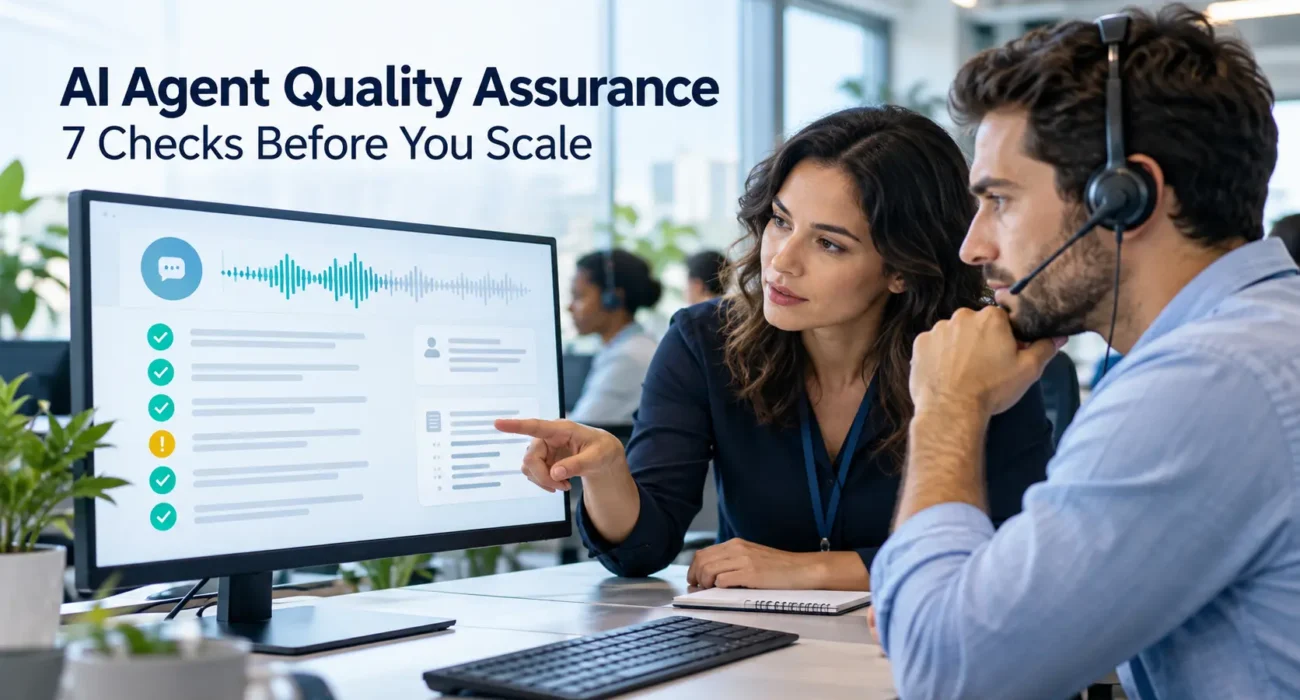
AI agent quality assurance checks whether an AI agent gives accurate answers, takes approved actions, and resolves the customer’s request. For contact centers adopting agentic AI, it provides a practical way to evaluate service quality before expanding automation.
An AI agent might sound confident while selecting the wrong workflow or promising a refund that never happens. A useful QA process checks the conversation and the outcome.
This guide explains seven checks your team can use, a sample scorecard, and a simple approach to ongoing monitoring.
Table of Contents
Why AI Agent Quality Assurance Matters In 2026
Deloitte Digital’s 2026 Global Contact Center Survey reports that 35% of contact centers already use agentic AI in their operations. As adoption grows, service leaders need evidence that automated workflows work as intended.
The evaluation challenge extends beyond answer quality. An agent may also retrieve information, select tools, update records, or initiate a transfer. Each step needs a clear definition of success.
For example, AWS’s guidance on agent evaluation covers tool selection, tool parameters, response accuracy, and goal completion. It also recommends repeated testing and ongoing evaluation.
What Should An AI agent QA Process Measure?
A practical evaluation follows the customer request from the first message to the final outcome. Start with these seven checks and adapt them to your workflows.
1. Did the agent understand the customer’s intent?
Test whether the agent identifies the actual request, including changes during the conversation. A customer who asks about a delayed order may later request cancellation. The agent needs to recognize that change.
Measure: Intent accuracy against a set of conversations labeled by qualified reviewers. Include ambiguous requests and conversations with more than one goal.
2. Was the answer supported by approved information?
Check answers against the current knowledge base and applicable policies. Review claims about prices, eligibility, timelines, and product details. An unsupported promise should trigger investigation even when the response sounds helpful.
Measure: Supported-answer rate and the frequency of material unsupported claims. Record the policy or source version used during each evaluation.
3. Did the requested task actually finish?
A polite closing message does not prove that a task succeeded. If the agent says it changed an appointment, verify the booking record. If it promises a refund, check the relevant transaction status.
Measure: Verified task completion among eligible requests. Define what counts as complete, pending, failed, or correctly escalated before scoring.
4. Did actions stay within approved limits?
Define which actions the agent can take independently and which require approval. Then test boundary cases, such as an adjustment above the permitted amount or a request involving another customer’s account.
Measure: Unauthorized action attempts, approval failures, and incorrect tool inputs. Pair interaction review with system logs where available.
5. Were required workflow steps followed?
List the identity checks, required language, consent steps, and escalation rules that apply to the workflow. Evaluate each relevant step separately so reviewers can locate the failure.
Measure: Applicable-step completion and critical failure counts. Have the relevant policy owner define the rules and severity levels.
6. Did the human handoff preserve context?
Test explicit requests for a person, unresolved problems, and situations outside the agent’s authority. A successful handoff should reach the correct team with the customer’s intent, completed steps, and unresolved issue.
Measure: Correct escalation rate, transfer completion, and the presence of required context. Review failed transfers separately from appropriate escalations.
7. Does quality hold up after changes?
Repeat important scenarios after changes to prompts, models, policies, tools, or knowledge sources. Use varied wording and multiple runs. Include noisy voice input and different languages where they are part of your service.
Measure: Changes in completion, unsupported claims, and critical failures by version, channel, and intent. Investigate declines before widening deployment.
A Practical AI Agent Quality Assurance Scorecard
Use this example as a starting point. The weights are illustrative; your team should set them according to customer impact and workflow risk.
| Quality dimension | Example weight | Evidence to review |
|---|---|---|
| Intent understanding | 10% | Request and reviewer-labeled intent |
| Answer accuracy | 20% | Response and approved source |
| Task completion | 25% | Confirmed system outcome |
| Action boundaries | 15% | Tool inputs and approval records |
| Required workflow steps | 15% | Applicable checklist and transcript |
| Human handoff | 10% | Transfer status and context |
| Customer communication | 5% | Clarity and accurate expectations |
Report critical failures separately from the weighted score. A high average can hide a serious unauthorized action. If a criterion does not apply, document that decision and normalize the remaining weights.
Track stability over time as a separate release measure. It shows whether a change improves performance across repeated evaluations.
How To Start An AI Agent QA Program
Choose one workflow with a clear outcome, such as appointment changes or order updates. Write down the expected steps, permitted actions, and escalation conditions.
Next, build a test set from appropriately protected customer scenarios. Include routine requests, incomplete information, tool failures, and exceptions. Ask experienced reviewers to agree on expected results.
Run the scenarios repeatedly and investigate disagreements between automated scores and human reviewers. Once the workflow is live, monitor incoming interactions, prioritize severe findings, and add confirmed failures to the test set.
For broader interaction review, explore VCloud Intelligence’s contact center assessment services.

Where Velora Fits into Interaction Quality Oversight
Velora™ by VCloud Intelligence supports interaction assessment with configurable QA scorecards, compliance checks, timestamped evidence, and operational insights.
These capabilities can help teams structure reviews and investigate findings. For AI agent workflows, discuss the available transcripts, action logs, and integration requirements with the VCloud team to establish the evaluation scope.
Ready to improve quality visibility? Request a Velora demo to discuss your current QA process and assessment needs.
