
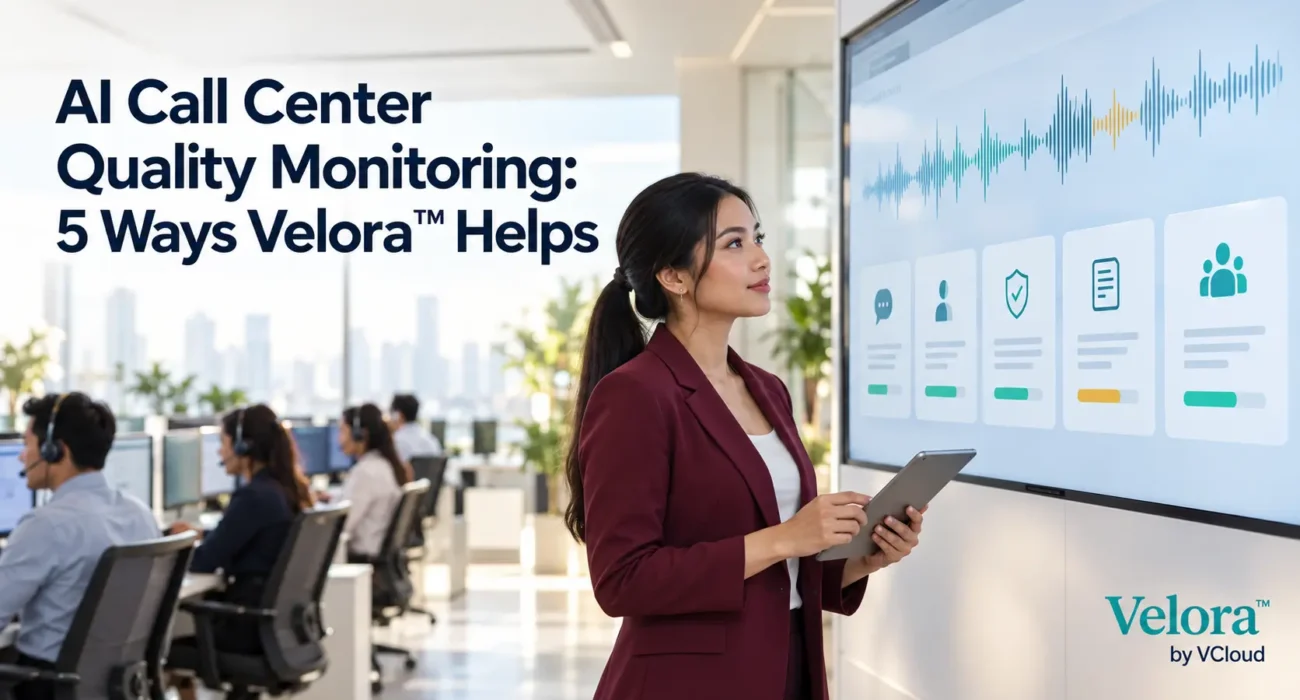
AI call center quality monitoring helps businesses assess customer conversations against defined service and compliance standards. For leaders, the opportunity is to connect quality findings with decisions that improve everyday operations.
A score can show that an interaction needs attention. However, teams also need to understand what happened, which evidence supports the finding, and what should happen next.
Velora™ by VCloud Intelligence supports that process through automated interaction assessment. Here are five ways to apply its capabilities to a practical quality program.
Table of Contents
What Is AI Call Center Quality Monitoring?
AI call center quality monitoring uses artificial intelligence to evaluate interactions against configured criteria. These may cover communication quality, process adherence, required language, and the use of approved information.
For voice operations, assessment depends on the call data or transcripts available. Contact center programs may also include digital channels.
A useful monitoring program combines automated assessment with expert review. Clear standards, reliable data, and regular calibration help make findings meaningful.
Expand Review Coverage Across Connected Interactions
Velora™ supports assessment across connected calls, chats, emails, and transcripts. Its platform is designed to help teams move beyond small QA samples.
Before rollout, define which conversations belong in the assessment. Confirm that recordings or transcripts arrive correctly and identify any missing records.
For example, reviewing every available transcript still leaves a gap if one queue is not connected. Coverage should be measured against the agreed scope, with exclusions made visible.
Apply Defined QA Scorecards
Velora™ evaluates areas such as script adherence, empathy, professionalism, call flow, and approved knowledge-base use.
To make scoring useful, turn broad expectations into clear criteria. “Explain the next step” is easier to evaluate when your standards describe what the customer should understand.
Then compare automated assessments with expert evaluations. Investigate disagreements before using the results to guide important performance decisions.
A consistent process needs both shared criteria and a way to challenge unclear findings.

Bring Evidence Into Compliance Review
Velora™ supports configured compliance checks, including required language and reporting processes, with timestamped evidence for findings.
For reviewers, evidence should answer a practical question: what happened in this conversation that requires attention?
Consider a flag for missing required language. A reviewer should check the relevant interaction, assess the context, and determine whether follow-up is needed.
Broad review coverage does not guarantee that every risk will be detected. Teams should validate results and keep people accountable for review decisions.
Make Coaching More Specific
An overall score rarely tells an agent exactly how to improve. A focused example creates a clearer discussion.
Use an evidence-backed finding to agree on one behavior to practice. For instance, an agent may need to explain a transfer before placing the customer on hold.
A practical coaching cycle includes:
- Reviewing the relevant interaction moment.
- Explaining the expected behavior.
- Practicing an improved response.
- Checking later interactions for progress.
Track whether the issue recurs. Completing a coaching session and changing a behavior are different outcomes.
Test Readiness With Simulated Conversations
Velora’s Automation Center uses AI callers for custom scenarios, onboarding simulations, and compliance checks.
Teams can use practice scenarios to explore how a workflow behaves before expanding it. Start with a normal request, then include an unclear question, an exception, and a situation requiring escalation.
Define the expected outcome before running the test. Otherwise, a fluent conversation can appear successful even when an important step was missed.
After changes, repeat the relevant scenarios to check whether the original problem has improved.

How to Start With AI Call Center Quality Monitoring
Choose one business priority, such as improving a specific QA category or reducing repeated escalation errors.
Next, establish a baseline and agree on the evidence you need. Confirm data availability, scoring criteria, review responsibilities, and follow-up procedures.
Measure results using indicators such as:
- Assessment coverage within the agreed scope.
- Agreement between automated findings and expert review.
- Time taken to investigate priority findings.
- Recurrence of selected quality issues.
- Improvement after coaching or process changes.
These measures help teams assess whether monitoring is contributing to a better operation.
Explore Velora™ by VCloud Intelligence
Explore Velora™ to learn about its interaction assessment capabilities.
VCloud brings contact center services, technology, managed teams, and Velora intelligence together. This connects quality assessment with the wider work of running customer operations. AI-Driven Contact Center Solutions
Visit vcloud.com to explore VCloud’s solutions, or contact VCloud Intelligence to discuss your assessment requirements.
