
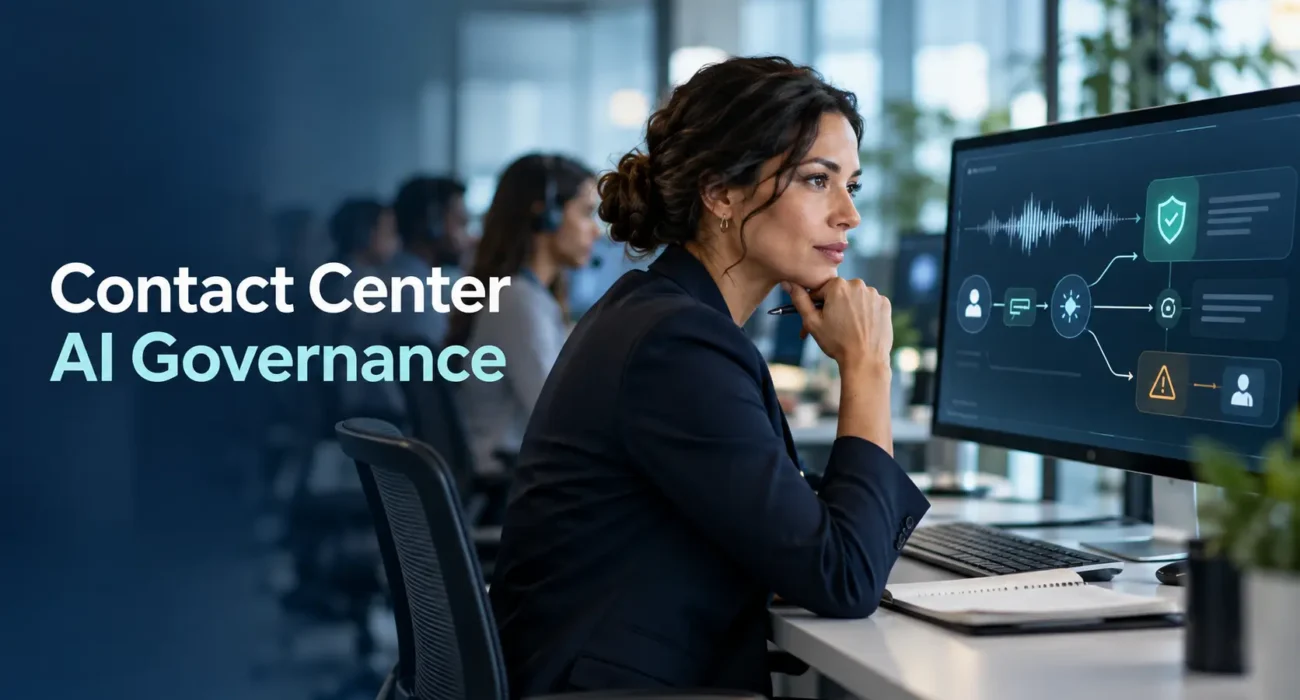
AI is becoming more capable inside the contact center.
It is no longer limited to answering simple questions or routing customers to the right department. Modern AI agents can understand intent, work across business systems, trigger workflows, and help resolve increasingly complex customer requests.
However, greater autonomy creates a new responsibility.
Organizations need to know what AI is allowed to do, how its decisions are monitored, when a person should intervene, and whether every customer interaction continues to meet quality and compliance standards.
That is why contact center AI governance is becoming an important part of modern customer experience strategy.
This topic is especially relevant now. In September 2026, Genesys introduced an AI Control Plane and new agentic orchestration capabilities designed to coordinate AI, people, and systems within defined controls. Salesforce has also expanded its enterprise agentic AI architecture around trusted controls as AI agents take on more complex work.
The future of AI in customer service is not simply more automation.
It is controlled, measurable, and accountable automation.
Table of Contents
What Is Contact Center AI Governance?
Contact center AI governance is the framework organizations use to define, monitor, control, and improve artificial intelligence operating within customer service environments.
A strong governance framework answers questions such as:
- What decisions can AI make independently?
- Which actions require human approval?
- What customer and business data can AI access?
- Which compliance rules must every interaction follow?
- How is AI performance measured?
- What happens when AI confidence is low?
- How are unusual interactions escalated?
- Can reviewers understand why an AI decision was made?
In simple terms, governance creates boundaries around AI autonomy.
As AI agents gain access to more workflows and systems, those boundaries become increasingly important.
NiCE’s recent contact center AI governance guidance similarly emphasizes clearly defined scope, ongoing monitoring, documentation, human escalation, and cross-functional oversight.
Why Agentic AI Changes the Contact Center
Traditional chatbots usually follow narrow workflows.
A customer asks a question, the bot looks for a predefined answer, and the interaction either ends or moves to a human employee.
Agentic AI can operate differently.
An AI agent may interpret what the customer wants, determine the steps required, access multiple systems, perform actions, and continue working toward a resolution.
Genesys describes its current agentic virtual-agent technology as capable of securely working across business systems and other AI agents to resolve more complex customer requests.
That creates significant opportunities for contact centers.
However, it also creates new risks.
For example, what happens if an AI agent:
- misunderstands customer intent?
- accesses the wrong information?
- uses an outdated knowledge source?
- misses mandatory language?
- takes an action outside its approved scope?
- fails to escalate a sensitive interaction?
- produces a result that cannot easily be explained?
Therefore, organizations need governance to grow alongside AI capability.
Contact Center AI Governance Starts With Clear Boundaries
The first step is defining what the AI is actually allowed to do.
Not every interaction carries the same level of risk.
For example, answering a routine business-hours question may require little human involvement.
However, changing sensitive account information, handling regulated information, or making a high-impact decision may require greater oversight.
A governance framework should therefore establish different levels of autonomy based on risk.
Teams can define:
- low-risk activities AI can complete independently
- activities AI can perform with monitoring
- actions requiring human approval
- scenarios that must immediately transfer to a person
- actions AI should never perform
This approach allows automation to scale without giving AI unlimited authority.
Current governance guidance from NiCE recommends defining exactly which decisions and transactions AI can handle autonomously and which require human review based on regulatory and risk considerations.
Human Oversight Remains Essential
AI automation does not remove the need for people. Instead, it changes where human judgment provides the most value.
AI can handle many predictable and repetitive tasks efficiently. However, complex, uncertain, sensitive, or high-risk interactions may still require human expertise.
For example, human intervention may be necessary when AI confidence is low, a conversation involves compliance-sensitive information, or an unusual customer request falls outside the system’s approved scope.
In addition, organizations should establish clear escalation rules for policy exceptions, high-risk transactions, and legal or safety-related situations.
As a result, employees remain accountable for the decisions that require judgment, while AI supports the more repetitive parts of the workflow.
Successful AI governance is therefore not about choosing between people and technology. Ultimately, it is about defining how humans and AI work together safely and effectively.
Quality Assurance Must Expand to AI Agents
Historically, contact center QA focused primarily on human employees.
Quality analysts reviewed calls, assigned scores, identified coaching opportunities, and monitored compliance.
However, when AI begins interacting directly with customers, quality assurance must expand as well.
Organizations should be able to evaluate AI interactions against questions such as:
Did the AI correctly understand customer intent?
Did it use approved information?
Was the answer accurate?
Did it follow the required workflow?
Did it use mandatory compliance language?
Did it escalate the interaction when required?
Was the final outcome correct?
This means the future of QA is not simply human-agent quality assurance.
It is interaction quality assurance across humans and AI.
NiCE’s 2026 Workforce Empowerment strategy reflects this shift by promoting one operating model for performance, quality, compliance, and governance across both human employees and AI agents.
Continuous Monitoring Is Critical for AI Governance
AI governance should not stop once a system is approved and deployed.
Customer behavior changes over time. Likewise, knowledge sources, policies, products, and operational processes continue to evolve.
Therefore, organizations need continuous monitoring to understand whether AI systems continue to perform according to defined standards.
For example, a single incorrect response may appear to be an isolated event. However, if the same issue occurs repeatedly across hundreds of interactions, it may indicate a larger quality, compliance, or knowledge problem.
As a result, continuous interaction monitoring can help teams identify recurring patterns earlier.
Organizations may uncover intent errors, incorrect responses, missing required language, unusual escalation patterns, or increasing human intervention rates.
Consequently, AI governance becomes proactive rather than reactive.
Move Beyond Small QA Samples
Traditional QA often depends on limited interaction sampling.
That creates visibility gaps even when only human agents are involved.
With AI agents processing interactions at greater speed and volume, those gaps become even more important.
Organizations need broader interaction visibility.
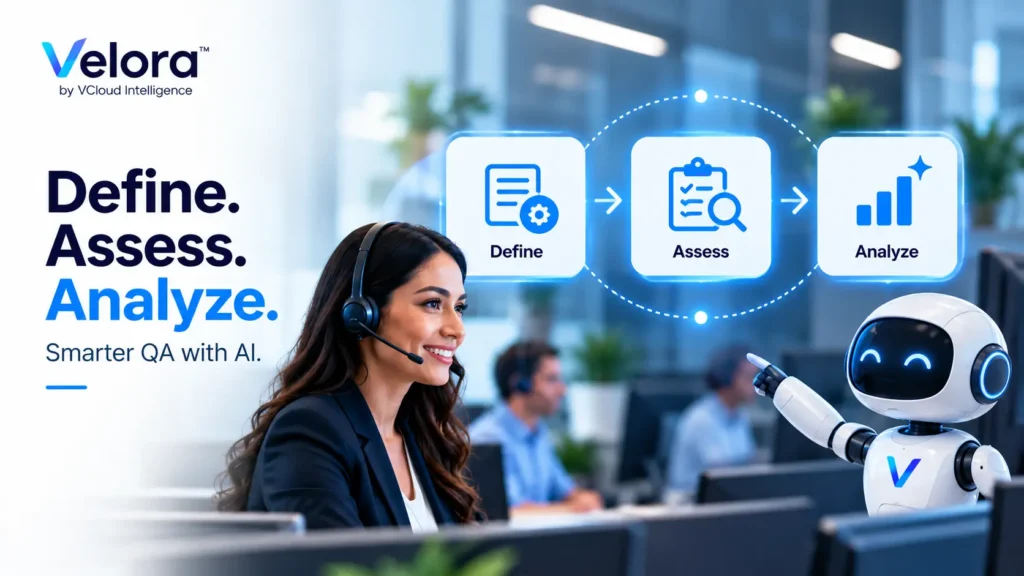
Velora™ is designed to help teams move beyond limited QA sampling by using AI to automatically evaluate customer interactions and transform quality assurance into a continuous assessment pipeline. VELORA
Instead of evaluating only a handful of conversations, teams can gain greater visibility across customer touchpoints.
This supports a stronger governance question:
Not simply,
“Did our sample perform correctly?”
but,
“What patterns are appearing across our interactions?”
Governance Requires Explainable Evidence
A score or alert can show that something requires attention. However, the result alone may not explain what happened.
Reviewers also need context.
For example, they should be able to determine where the issue occurred, why it was flagged, which policy was affected, and what evidence supports the finding.
Velora™ supports automated QA and compliance assessment with explanations and timestamped evidence.
Therefore, teams can review relevant findings more quickly instead of manually searching through entire interactions.
Furthermore, explainable evidence can support investigations, coaching, compliance reviews, and audit preparation.
Test AI Before Customers Encounter the Problem
Organizations should not wait for real customers to discover AI weaknesses.
Testing should happen before deployment and continue as workflows evolve.
This is especially important for agentic AI because AI agents may encounter scenarios that were not included in the original implementation plan.
Organizations can test situations such as:
- normal customer requests
- unusual intents
- difficult questions
- compliance-sensitive conversations
- escalation scenarios
- incorrect customer information
- policy exceptions
- low-confidence responses
- high-risk interactions
Velora™ includes an Automation Center that uses AI agents to simulate real-world interactions. The supplied platform reference describes custom scenario creation, AI mystery-shop testing, mock calls, and automated assessment after simulated interactions. VELORA
This provides teams with an opportunity to identify vulnerabilities earlier.
Contact Center AI Governance and Compliance
AI does not remove those requirements. Instead, organizations must ensure that automated interactions follow them consistently. Moreover, governance controls should connect AI behavior directly to defined compliance standards.
A governance framework should therefore connect AI behavior directly to compliance standards.
For example, organizations may establish automated checks for:
- mandatory language
- prohibited advice
- required disclosures
- escalation procedures
- policy adherence
- approved knowledge usage
- regulatory reporting triggers
Velora™ was built with compliance assessment as a core part of its interaction-evaluation model. The platform reference describes detection of adverse events, product complaints, mandatory reporting workflows, required regulatory language, and other compliance indicators in pharmaceutical contact centers. VELORA
This same principle applies more broadly:
AI automation should operate within clearly defined compliance boundaries.
From AI Monitoring to Operational Intelligence
Governance does more than prevent problems. In addition, it can create valuable operational intelligence.
When organizations continuously evaluate AI and human interactions, they can identify patterns affecting the entire contact center.
For example, a high AI escalation rate may indicate a knowledge gap. Similarly, repeated transfers may reveal routing problems, while an increase in low-confidence responses may show where knowledge resources need improvement.
Consequently, governance data can become a valuable source of operational insight.
The Rise of the AI Control Plane
One of the clearest contact-center technology trends in 2026 is the move toward centralized AI control.
As businesses deploy more AI agents, they need visibility across all of them.
Genesys introduced an AI Control Plane in September 2026 as part of its agentic orchestration strategy, combining AI, human workers, business systems, governance, and controls within a coordinated environment. Genesys
Salesforce is moving in a similar direction with its Trusted Enterprise AI Harness, which is designed to give AI agents the shared context and enterprise controls required to perform increasingly complex work. Salesforce
This represents an important change.
Businesses are moving from managing individual AI applications to governing entire AI ecosystems.
Contact center leaders should prepare for that shift.
A Practical Contact Center AI Governance Framework
Organizations do not need to make AI governance unnecessarily complicated.
A practical framework can begin with six steps.
1. Define AI Scope
Determine which use cases, customer interactions, systems, and actions AI is allowed to handle.
Set clear restrictions for sensitive or high-risk situations.
2. Establish Quality and Compliance Standards
Define QA scorecards, required language, business policies, knowledge sources, security expectations, and compliance rules.
3. Test Before Deployment
Use controlled scenarios and simulations to verify that AI behaves correctly before expanding automation.
4. Monitor Interactions Continuously
Evaluate AI performance, quality, compliance, intent accuracy, risk indicators, and operational trends.
5. Maintain Human Escalation
Create clear pathways for human intervention when AI confidence is low or the situation requires judgment.
6. Review Evidence and Improve
Use findings, trends, evidence, and customer outcomes to improve AI policies and workflows over time.
This transforms governance from a document into an operating process.
Why AI Governance Builds Customer Trust
Customers may never see an AI governance framework.
However, they experience its results.
They notice when information is accurate.
They notice when an AI understands their request.
They notice whether escalation works smoothly.
They notice when the organization protects their information.
Most importantly, customers experience the consequences when AI gets something wrong.
Therefore, AI governance ultimately supports trust.
Strong governance helps organizations balance automation with accountability.
It also helps teams expand AI without sacrificing the quality standards customers expect.
How Velora™ Supports Governance-Ready Contact Centers
Velora™ is designed to provide interaction-level visibility across quality, compliance, risk, and operational performance.
Its capabilities include automated interaction assessment, QA scoring, compliance checks, supporting evidence, datapoint extraction, scenario simulation, and operational analysis. VELORA
For organizations adopting more AI, these capabilities can support a broader governance strategy.
Teams can define standards.
Interactions can be evaluated against those standards.
Issues can be supported with evidence.
Patterns can be analyzed.
Humans can then focus attention on the areas where judgment and action are needed most.
Organizations can explore Velora™ to understand how interaction intelligence can support stronger quality, compliance, and operational oversight.
VCloud Intelligence’s AI-Powered Contact Center Assessment can also help organizations identify QA, compliance, workflow, and operational gaps before expanding automation.
The Future Is Agentic — but It Must Also Be Governed
Agentic AI is quickly becoming a major part of the contact center technology landscape.
Recent developments from Genesys, Salesforce, and NiCE all point toward the same broader shift: AI agents are becoming more capable, while governance, orchestration, human oversight, and continuous monitoring are becoming more important.
The key question is no longer simply:
Can AI perform this task?
Organizations also need to ask:
Should AI perform it?
What rules should it follow?
How will performance be monitored?
When should a human intervene?
How will we prove what happened afterward?
Those questions define effective contact center AI governance.
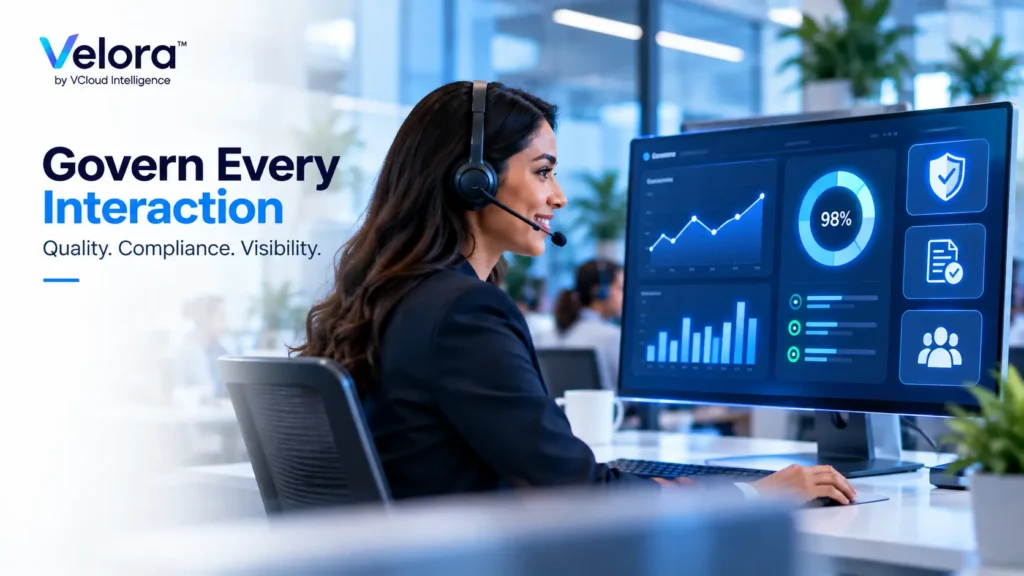
Govern Every Interaction
AI innovation and governance should work together.
Organizations can scale automation while still maintaining quality, compliance, human accountability, and operational visibility.
The key is to build governance into the interaction lifecycle rather than adding it after problems appear.
Define the boundaries. Monitor the interactions. Keep humans accountable. Improve continuously.
That is how organizations can scale agentic AI with greater confidence.
Explore Velora™ by VCloud Intelligence to see how AI-powered interaction intelligence can support quality, compliance, risk visibility, and governance-ready contact center operations.
