

Contact center performance cannot be understood through a few metrics or a small sample of customer conversations.
However, many organizations still rely on manual reviews, disconnected reports, and limited interaction sampling to evaluate how effectively their contact center is operating.
As a result, quality issues, compliance concerns, coaching opportunities, and workflow problems may remain hidden.
A contact center performance assessment provides a more structured way to understand what is happening across customer interactions, teams, processes, and operational workflows.
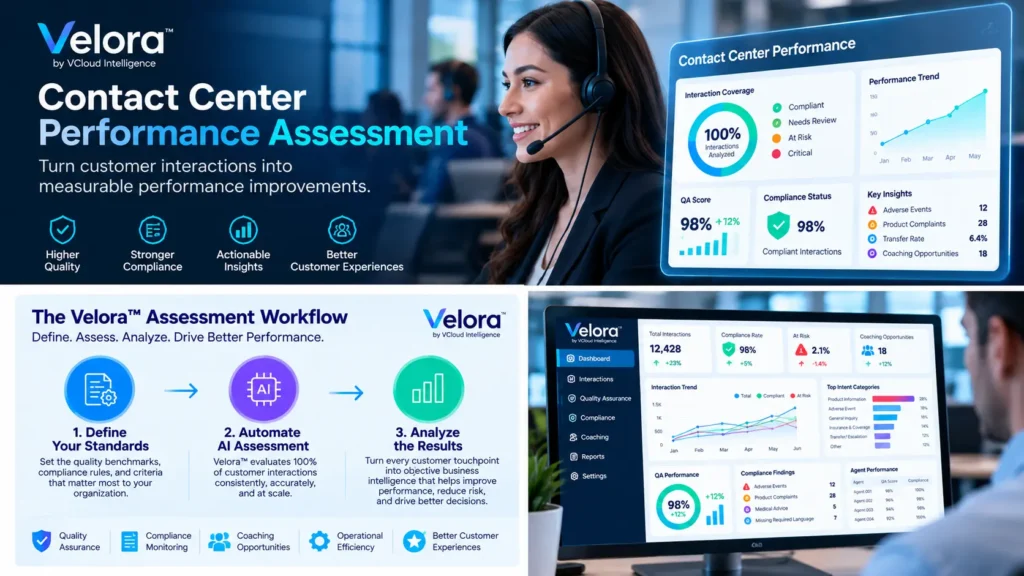
With AI-powered interaction intelligence from Velora™ by VCloud Intelligence, organizations can move beyond traditional sampling and evaluate customer conversations at a much broader scale. Velora™ is designed to assess interactions consistently while providing QA, compliance, risk, and operational insights that teams can use to improve performance. VCloud Intelligence
The goal is simple:
Understand performance. Identify gaps. Take action.
Table of Contents
What Is a Contact Center Performance Assessment?
A contact center performance assessment is a structured evaluation of how effectively a contact center delivers customer service while meeting quality, compliance, and operational expectations.
Traditionally, performance assessments may review areas such as:
- agent performance
- service quality
- quality assurance scores
- customer satisfaction
- process efficiency
- compliance performance
- workforce adherence
- technology effectiveness
- operational workflows
The older version of this article also emphasized common indicators such as First Call Resolution, Average Handle Time, Customer Satisfaction, QA scores, agent adherence, retention, and compliance performance. Gan Jing World
However, modern assessments can go further.
Rather than examining only dashboard metrics, organizations can analyze what actually happened inside customer conversations.
This adds valuable context behind the numbers.
Why Traditional Performance Reviews Have Limitations
Traditional contact center assessments frequently depend on manual QA sampling.
A supervisor or quality analyst selects a small number of interactions, evaluates them, assigns scores, and identifies coaching opportunities.
This approach can provide useful information.
However, it also creates blind spots.
If thousands of conversations occur each day but only a small number are reviewed, leadership may be making decisions based on a limited picture of performance.
Additionally, manual scoring can vary between reviewers.
One evaluator may interpret a behavior differently from another. Therefore, performance comparisons across agents, teams, or locations may become less consistent.
VCloud Intelligence’s current assessment approach addresses these limitations by analyzing conversations at scale and applying more consistent AI-based scoring across interactions.
How AI Changes Contact Center Performance Assessment
Artificial intelligence makes it possible to evaluate customer interactions differently.
Instead of using interaction data only for storage or reporting, AI can examine conversations for quality, compliance, intent, workflow adherence, and recurring operational patterns.
Velora™ is built around this approach.
The platform evaluates calls, chats, emails, transcripts, and other connected customer interactions against defined QA scorecards, compliance requirements, regulatory language, and approved knowledge sources. VCloud Intelligence
Consequently, organizations can gain a more complete view of performance.
Rather than asking:
“How did the calls we sampled perform?”
Teams can begin asking:
“What patterns are appearing across our customer interactions?”
That difference is important.
Evaluate Quality Assurance Performance
Quality assurance remains an important part of any contact center performance assessment.
However, strong QA should provide more than a final score.
Teams need to understand which behaviors are influencing the result.
For example, an assessment may examine:
- script adherence
- professionalism
- empathy
- interaction control
- approved knowledge usage
- intent accuracy
- call flow
- transfer handling
- escalation accuracy
Velora™ applies automated QA scorecards across interactions and supports findings with explanations and evidence.
Therefore, teams can identify not only where performance is weak but also what may be contributing to the problem.
Assess Compliance Alongside Performance
Performance and compliance should not be evaluated completely separately.
A customer interaction can provide excellent service while still missing an important requirement.
Likewise, an interaction may follow a required process while revealing other quality problems.
For compliance-driven organizations, this connection is especially important.
Velora™ can evaluate compliance indicators alongside QA criteria and surface potential issues that require additional review. Its current capabilities include compliance checks, required-language analysis, risk detection, and supporting evidence for review. VCloud Intelligence
As a result, organizations can examine performance through both an operational and governance lens.
Move Beyond Limited QA Sampling
Sampling is one of the largest limitations of traditional performance assessment.
Even a well-designed sample represents only part of the operation.
Important trends may exist in conversations that no one selected for review.
Velora™ is designed to review 100% of connected customer interactions instead of relying exclusively on small QA samples.
This broader interaction coverage can help teams identify:
- recurring QA issues
- compliance gaps
- coaching needs
- escalation patterns
- process breakdowns
- transfer trends
- customer intent patterns
- service-quality problems
Therefore, a performance assessment becomes less dependent on isolated examples.
Instead, teams can evaluate recurring patterns across the operation.
Identify the Cause Behind Performance Trends
Metrics tell teams what happened.
Customer interactions can help explain why.
For example, an increase in Average Handle Time may indicate a process problem, knowledge gap, or difficult transfer workflow.
A reduction in QA scores might be connected to a specific script requirement.
Meanwhile, repeated escalations could reveal inaccurate routing or gaps in agent knowledge.
This is where interaction intelligence adds value.
By connecting performance results with actual customer conversations, organizations can gain more context behind operational trends.
As a result, improvement efforts can become more targeted.
Turn Performance Findings Into Coaching Opportunities
A strong contact center performance assessment should help teams improve, not simply document problems.
Coaching is one of the most valuable outcomes.
Traditional QA may identify coaching needs from a handful of interactions. However, AI-powered analysis allows organizations to examine whether the same behaviors appear repeatedly.
For example, an assessment might reveal recurring issues related to:
- knowledge accuracy
- customer handling
- script adherence
- escalation procedures
- interaction control
- transfer handling
- required language
When patterns become visible, supervisors can prioritize coaching based on evidence.
Consequently, training becomes more focused on the behaviors that are actually affecting performance.
Analyze Operational Workflows
Contact center performance is influenced by more than individual agent behavior.
Processes also matter.
Transfers, routing decisions, escalations, holds, workflow handoffs, and knowledge access can all affect the customer experience.
Therefore, a modern performance assessment should examine operational workflows as well.
Velora™ can extract operational data points such as transfer status, transfer reason, customer intent, and escalation category.
This helps organizations investigate questions such as:
Why are certain interactions being transferred?
Which customer intents create the most friction?
Where are escalations occurring?
Are certain workflows causing repeated problems?
Where could processes be simplified?
These insights help connect customer conversations with operational improvement.
Build More Consistent Performance Measurement
Consistency matters when evaluating performance.
If scoring standards vary between reviewers, teams may struggle to compare results accurately.
AI-powered assessments can help apply the same defined evaluation logic across interactions.
VCloud Intelligence’s current Contact Center Assessment specifically emphasizes consistent AI-based scoring across teams and evaluators.
This provides a more repeatable foundation for analyzing performance.
Moreover, leaders can identify whether performance differences are connected to actual interaction behavior rather than differences in reviewer interpretation.
Use Evidence to Support Performance Findings
A performance score is more valuable when teams can understand why it was assigned.
Velora™ supports QA and compliance findings with explanations and timestamped evidence.
This can make performance review more efficient.
Instead of listening to an entire conversation to understand a markdown, reviewers can focus on the relevant interaction segment.
Furthermore, evidence helps managers explain findings during coaching sessions.
Teams can see:
What happened?
Where did it happen?
Why did it affect the assessment?
Which standard was involved?
Consequently, performance discussions can become more objective and actionable.
Connect Contact Center Performance With Customer Experience
Operational performance and customer experience are closely connected.
Customers experience the impact of internal processes directly.
Long transfers, inconsistent answers, unnecessary escalations, poor interaction control, and knowledge gaps can all affect customer confidence.
Therefore, a contact center performance assessment should examine both operational efficiency and interaction quality.
When teams understand the patterns inside customer conversations, they can identify improvements that benefit both agents and customers.
For example, improving knowledge resources may reduce handling difficulty.
Better routing may reduce unnecessary transfers.
Targeted coaching may improve communication consistency.
As a result, performance improvement can contribute to a more consistent customer experience.
Contact Center Performance Assessment vs. Operational Assessment
The terms contact center performance assessment and contact center operational assessment are closely related.
However, they emphasize slightly different areas.
A performance assessment focuses primarily on how effectively agents, teams, and processes achieve defined quality and service objectives.
An operational assessment takes a broader view that may also examine technology, workflows, workforce processes, governance, reporting, and organizational structure.
The strongest approach often combines both perspectives.
Performance data shows where results are changing.
Operational analysis helps explain which systems or processes may be contributing to those results.
Therefore, organizations gain a more complete view when they evaluate both performance outcomes and the workflows behind them.
What Should a Modern Contact Center Assessment Evaluate?
A modern assessment should provide visibility across several layers of the operation.
These can include:
Quality Assurance
Evaluate scoring consistency, interaction quality, agent behavior, communication standards, and coaching opportunities.
Compliance
Identify potential policy, regulatory, disclosure, or workflow gaps that may require review.
Customer Interaction Quality
Understand professionalism, intent accuracy, customer handling, sentiment patterns, and interaction outcomes.
Operational Performance
Examine transfers, routing, escalation handling, workflow efficiency, and recurring process problems.
Coaching Opportunities
Identify performance patterns that can support targeted training and development.
Risk Visibility
Surface recurring behaviors or interaction patterns that may create operational or compliance exposure.
VCloud Intelligence’s current assessment platform evaluates these areas using interaction intelligence rather than relying entirely on isolated manual reviews.
Make Contact Center Assessment an Ongoing Process
A performance assessment should not necessarily be a one-time project.
Customer needs change.
Processes change.
Agents develop new skills.
Compliance requirements may evolve.
Furthermore, new products, workflows, and interaction channels can introduce new performance challenges.
Therefore, continuous monitoring provides significantly more value than occasional reviews alone.
The original version of this article already emphasized continuous improvement as an important part of contact center assessment.
AI-powered interaction intelligence strengthens that approach by making broader and more consistent analysis possible.
Instead of waiting months to discover a trend, teams can maintain clearer visibility into performance over time.
How Velora™ Supports Contact Center Performance Assessment
Velora™ turns interaction data into structured intelligence for QA, compliance, risk, and operational performance.
Its current workflow follows three main stages:
Define Standards
Configure QA scorecards, compliance requirements, required language, knowledge sources, and operational triggers.
Assess Interactions
Evaluate conversations consistently for quality, accuracy, risk, and workflow adherence.
Analyze Results
Review scores, supporting evidence, trends, routing insights, and coaching opportunities. VCloud Intelligence
This approach transforms performance assessment from a manual reporting exercise into a more scalable intelligence process.
Teams gain the ability to understand not only what is happening, but also why it is happening and where action may be needed.
Turn Assessment Into Action
The purpose of a contact center performance assessment is not simply to create another report.
It is to improve operations.
A useful assessment should help organizations identify what deserves attention and determine what to do next.
That may include:
- improving QA standards
- strengthening compliance processes
- refining coaching programs
- correcting workflow problems
- improving routing
- updating knowledge resources
- addressing recurring risks
- improving operational reporting
The value comes from turning findings into action.
Build a Clearer View of Contact Center Performance
Modern contact centers generate enormous amounts of interaction data.
However, data alone does not create visibility.
Organizations need a structured way to evaluate customer conversations, identify patterns, measure performance, and understand where improvement opportunities exist.
A contact center performance assessment provides that foundation.
With AI-powered interaction intelligence, organizations can move beyond limited manual sampling and gain a broader view of quality, compliance, coaching, risk, and operational performance.
Assess performance. Understand the cause. Take action.
Organizations ready for a broader evaluation can explore VCloud Intelligence’s AI-Powered Contact Center Assessment.
For ongoing enterprise interaction intelligence, explore Velora™ and see how VCloud Intelligence can support quality, compliance, and operational visibility.
