

Pharmaceutical contact center QA helps teams assess how customer conversations follow approved quality, safety, and operational standards. A useful program needs both broad interaction visibility and clear evidence for decisions.
When teams review only selected conversations, they may miss patterns that deserve investigation. Yet increasing review volume alone is not enough. Leaders also need to know which standards were checked and what happens when an issue appears.
Velora™ by VCloud supports AI-powered interaction assessment. The six checks below offer a practical starting point for evaluating its role in your operation.
Table of Contents
What Is Pharmaceutical Contact Center QA?
Pharmaceutical contact center quality assurance evaluates conversations against an organization’s approved scorecards, knowledge sources, and procedures.
It can examine communication quality, required language, escalation steps, and how agents respond to potential safety concerns or product complaints. The applicable standards should be defined by the organization’s qualified process owners.
AI can support this work, while people remain accountable for validating findings and handling exceptions.

1. Confirm Which Interactions Are Included
Velora™ supports assessment across connected calls, chats, emails, and transcripts, helping teams move beyond small QA samples.
Before relying on 100% coverage, confirm what that figure includes. List eligible channels, queues, interaction types, available records, and exclusions.
For example, assessing all received transcripts still leaves a gap if one queue is not connected. Reconcile assessed records with source-system totals so missing conversations remain visible.
2. Test Potential Safety and Complaint Flags
Velora™ can flag potential adverse events and product complaints and assess whether configured reporting steps were followed.
Test the assessment using approved, expert-reviewed examples. Include conversations that should trigger review as well as similar conversations that should not.
A flag is a starting point for qualified assessment. It is not a final safety determination, and full review coverage does not guarantee detection of every concern.
Agree on who reviews findings and how they enter the organization’s established process.
3. Check Approved Language and Process Adherence
Velora™ supports configured checks for required language, medical-advice risks, and reporting flow.
Confirm that evaluation criteria reflect current approved guidance. A rule based on an outdated script can create misleading findings even when the assessment runs consistently.
When a procedure changes, review the related criteria and test examples again. Keep ownership of standards clear so QA, operations, and relevant specialists understand which version applies.
4. Review Scores Alongside Their Evidence
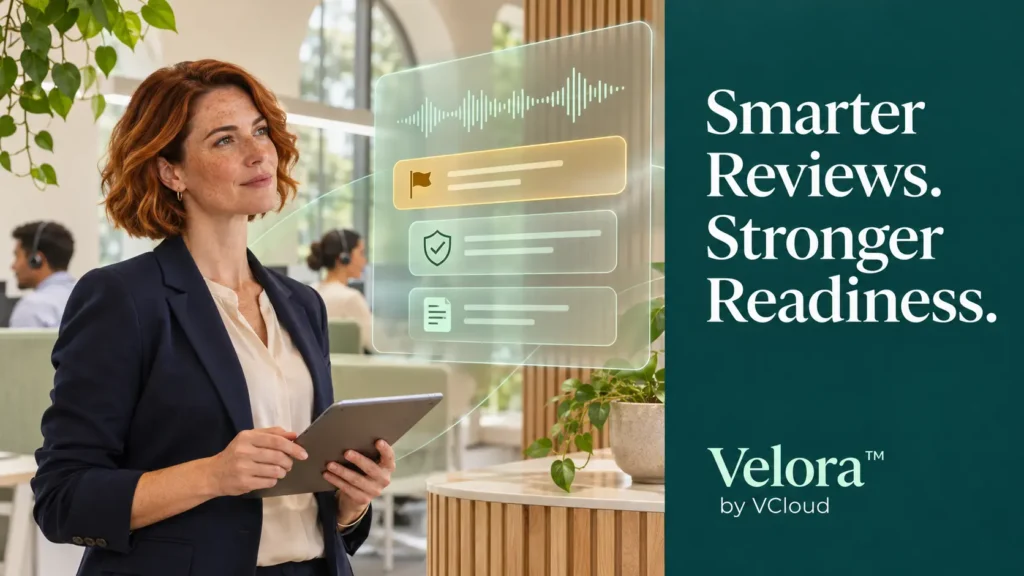
Velora™ provides QA scorecards and timestamped evidence explaining assessment findings.
Choose a scored interaction and ask a reviewer to reproduce the decision. Can they locate the relevant moment, understand the criterion, and judge whether the finding is supported?
Compare automated assessments with expert review. Investigate disagreements at the individual criterion level rather than relying only on agreement between overall scores.
Clear evidence makes review discussions more specific and helps teams identify where criteria need clarification.
5. Turn Repeated Findings Into a Defined Response
A pattern across interactions may point to an agent skill gap, unclear guidance, or a process problem.
For example, suppose several agents struggle to explain the same transfer step. Review the supporting examples and ask agents what makes the process difficult before choosing an intervention.
Assign an owner, define the action, and decide how progress will be checked. A coaching session, guidance update, and routing correction address different causes.
This is a suggested operating practice, rather than a claim that Velora automatically manages those actions.
6. Test Readiness With Simulated Scenarios
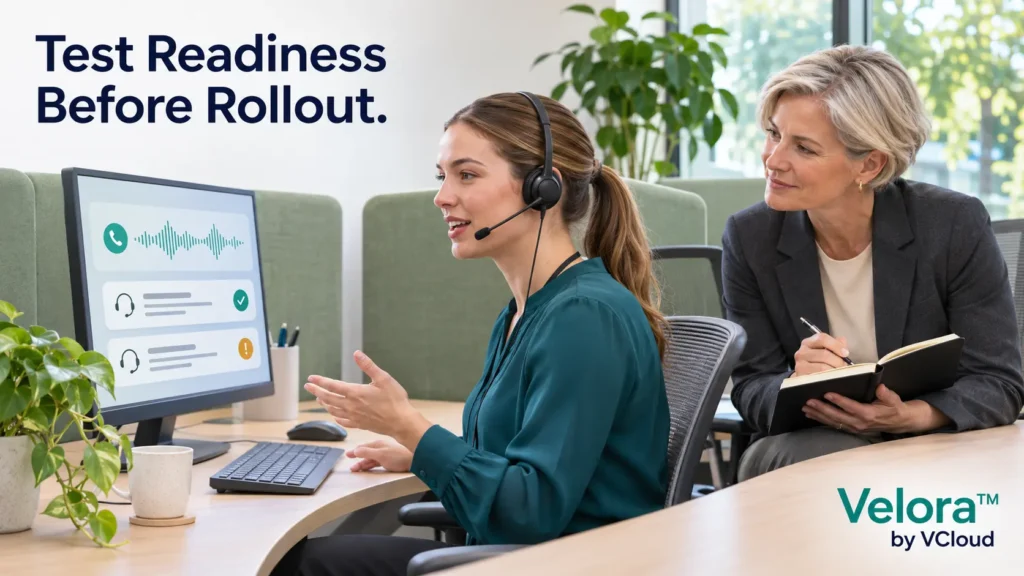
Velora’s Automation Center uses AI callers for custom scenarios, onboarding simulations, and compliance checks.
Start with approved scenarios that represent both routine requests and situations requiring escalation. Define the expected behavior before testing.
After a workflow or training change, repeat relevant scenarios. This helps teams check whether the original weakness has improved before expanding the approach.
Simulations complement ongoing review; they cannot represent every situation a customer may raise.
A Pharmaceutical Contact Center QA Checklist
| Area | Evidence to request | Question to answer |
|---|---|---|
| Coverage | Source-to-assessment reconciliation | Which eligible interactions are missing? |
| Safety and complaints | Expert-reviewed test examples | Are relevant concerns being flagged appropriately? |
| Approved standards | Current criteria and guidance versions | Are we evaluating the right process? |
| Scoring | Findings with supporting timestamps | Can a reviewer validate the result? |
| Improvement | Owner, action, and follow-up record | Did the selected issue become less frequent? |
| Readiness | Scenario results against expected behavior | What needs attention before rollout? |
Use this checklist as an evaluation aid and adapt it to your approved procedures.
Introduce Velora™ Through a Focused Pilot
Choose one defined workflow and confirm the connected data, assessment criteria, and review responsibilities.
Then compare results with expert-reviewed examples. Track coverage gaps, agreement on findings, review effort, and recurring issues.
Expand when your team has enough evidence to understand performance and handle exceptions. A clear pilot provides a stronger basis for decisions than an attractive demonstration alone.
Explore Velora™ by VCloud
Explore Velora™ to learn about its interaction assessment and simulation capabilities.
VCloud brings contact center services, technology, and Velora intelligence together, connecting quality assessment with wider operations. AI-Driven Contact Center Solutions
Visit vcloud.com or contact VCloud Intelligence to discuss your pharmaceutical contact center QA requirements.
Smarter audits and stronger oversight begin with clear standards, reviewable evidence, and accountable action.
