
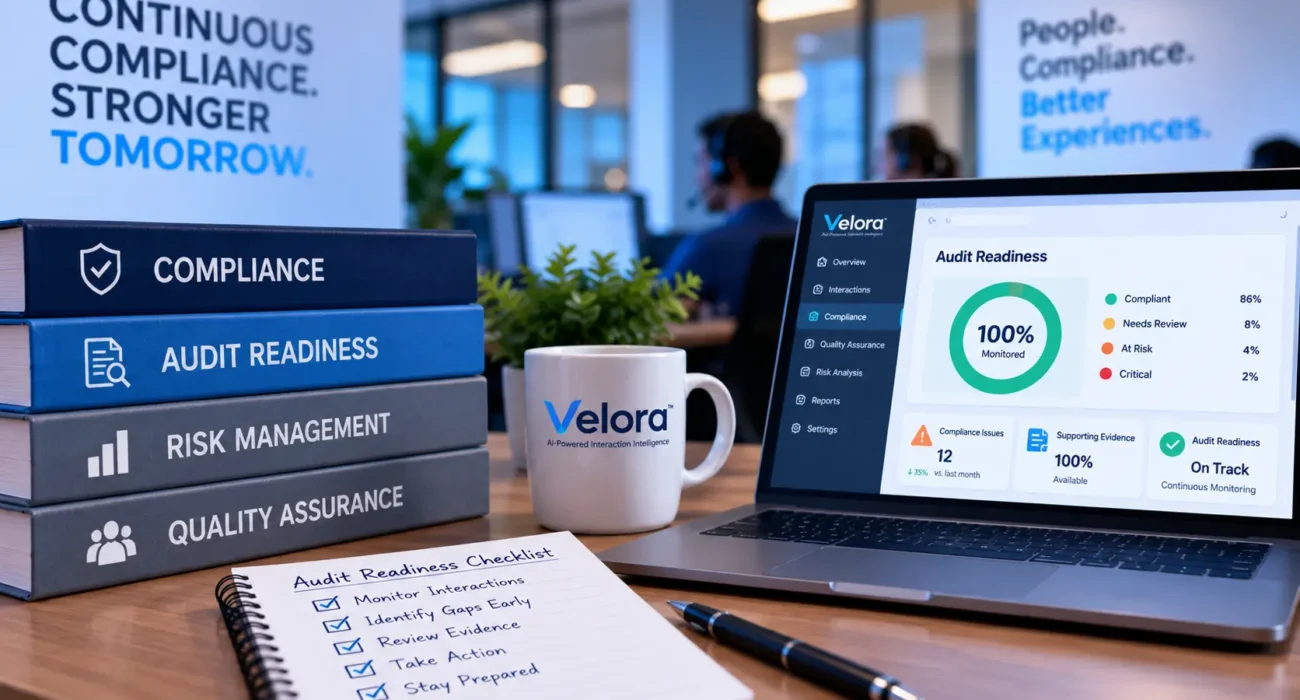
An audit should confirm that your compliance processes are working.
It should not be the moment you discover that something went wrong.
However, many contact centers still rely on limited manual reviews, fragmented reporting, and periodic compliance checks. As a result, potential gaps can remain hidden until an audit, escalation, or regulatory review brings them to the surface.
Contact center audit readiness requires a different approach.
Instead of preparing only when an audit is approaching, organizations need continuous visibility into compliance performance, supporting evidence, and emerging risks.
That is where Velora™ can help.
Velora™ uses AI-powered interaction intelligence to help organizations evaluate customer interactions at scale, identify potential compliance issues earlier, and maintain clearer evidence for review. Consequently, compliance teams can spend less time searching for problems and more time addressing them before they become larger issues.
Organizations can explore Velora™ to learn more about its interaction auditing, compliance, QA, and evidence capabilities.
Table of Contents
Why Contact Center Audit Readiness Matters
Audit readiness is not simply about having documentation available.
It is about being able to demonstrate that compliance requirements are consistently understood, followed, monitored, and supported by evidence.
For contact centers, this can become difficult very quickly.
Thousands of customer conversations may occur every day across calls, chats, emails, and other channels. Meanwhile, traditional QA teams can usually review only a fraction of them.
Therefore, important compliance questions may remain unanswered.
Did agents consistently use required language?
Were escalation procedures followed correctly?
Were potential regulatory events identified?
Did employees follow the approved workflow?
Can reviewers quickly locate evidence supporting a compliance decision?
When visibility is limited, organizations may not discover the answers until someone starts investigating.
A continuous approach to contact center audit readiness changes that dynamic by helping teams understand compliance performance before an audit begins.
An Audit Should Confirm Compliance, Not Discover It
Traditional audit preparation can become reactive.
Teams may begin gathering records, reviewing interactions, checking scorecards, and searching for evidence shortly before an audit.
However, discovering a recurring compliance problem during that process creates unnecessary pressure.
The better approach is to make audit readiness part of everyday operations.
With continuous compliance monitoring, organizations can identify potential issues as interactions are evaluated rather than waiting for a periodic review.
For example, a recurring required-language gap may indicate that agents need clearer guidance. Similarly, repeated workflow failures could reveal a process problem rather than an isolated employee mistake.
Once those trends become visible, teams can investigate the cause and take corrective action earlier.
As a result, audits become less about discovering unknown problems and more about demonstrating the effectiveness of existing controls.
From Limited Sampling to Continuous Compliance Visibility
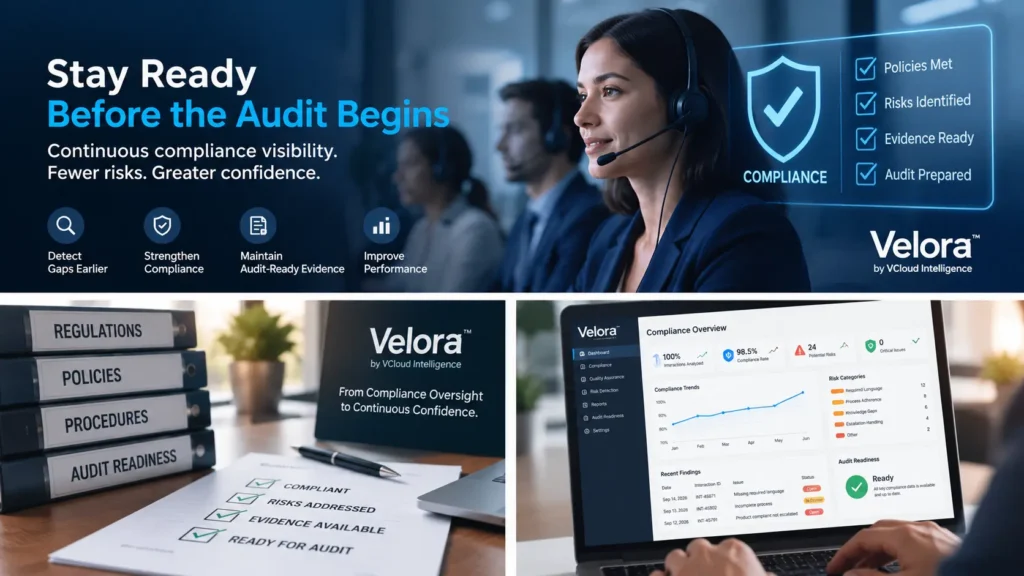
One of the biggest challenges with traditional QA is sampling.
A contact center may handle thousands of interactions while its QA team manually reviews only a small percentage.
That creates a visibility gap.
Even a well-designed sample cannot guarantee that every important compliance issue will appear in the conversations selected for review.
Velora™ addresses this problem by evaluating customer interactions at enterprise scale against defined compliance rules, QA standards, regulatory language, and approved knowledge sources.
Consequently, organizations can move beyond isolated examples and develop a broader understanding of their compliance environment.
Instead of asking:
“Did the interactions we sampled meet our requirements?”
Teams can begin asking:
“What compliance patterns are appearing across our interactions?”
That is a much stronger foundation for contact center audit readiness.
Detect Compliance Gaps Before They Become Bigger Issues
A small compliance problem can become a much larger issue when it occurs repeatedly.
For example, one missed disclosure may require individual coaching. However, the same disclosure being missed across a team could indicate a training, workflow, or knowledge-management problem.
Continuous monitoring helps teams distinguish between those situations.
Velora™ can help surface interaction-level issues and broader patterns so compliance and QA teams can determine where attention is required.
In regulated contact center environments, the platform can evaluate areas such as required regulatory language, escalation handling, product complaints, adverse events, and other defined compliance indicators. Its current product positioning also emphasizes explaining what was flagged, where it occurred, and the supporting evidence behind the assessment.
Therefore, teams gain both visibility and context.
That context matters because identifying a potential risk is only the beginning. Organizations also need enough information to understand the issue, investigate it, and determine the appropriate response.
Audit-Ready Evidence Matters
Compliance teams do not only need a result.
They need evidence.
A finding without supporting context can create additional work because reviewers must return to the original interaction and determine exactly what happened.
Velora™ is designed to provide supporting information alongside its assessments, including scoring explanations, issue locations, and timestamped evidence.
This can make reviews more efficient.
For instance, rather than searching through an entire interaction to understand why something was flagged, a reviewer can focus on the relevant portion and evaluate the supporting information.
Furthermore, structured evidence creates greater consistency across compliance reviews.
It helps teams answer important audit questions such as:
- What was identified?
- Where did it occur?
- Why was it considered important?
- Which standard was affected?
- What evidence supports the finding?
When this information is available throughout the year, audit preparation becomes significantly more organized.
Make Compliance Monitoring Part of Everyday Operations
Strong contact center audit readiness is built before anyone schedules the audit.
That means compliance monitoring should become part of normal operating processes rather than a separate activity performed periodically.
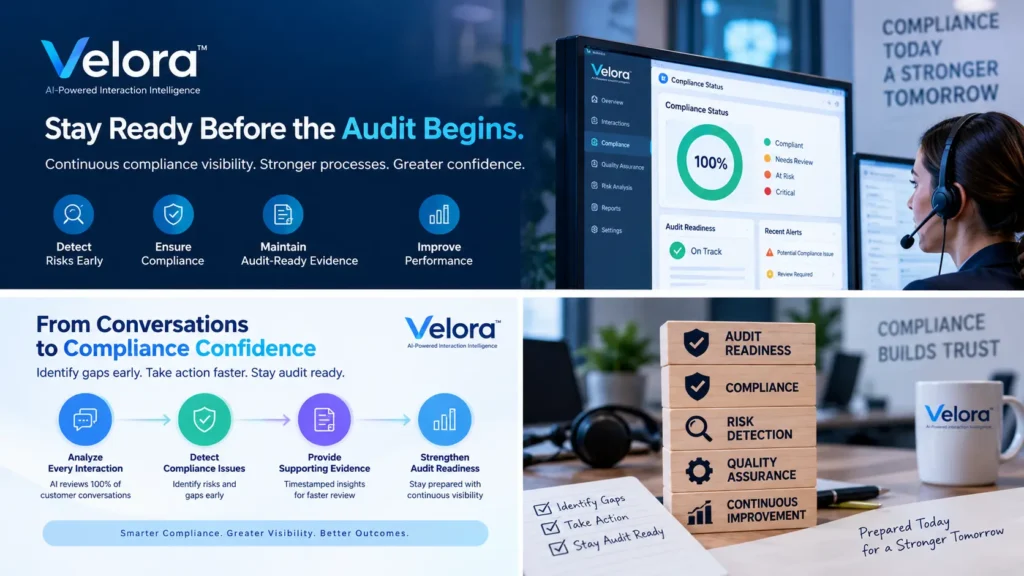
Velora™ follows a structured workflow that supports this approach.
Define the Standards
First, organizations establish the compliance rules, QA scorecards, required language, operational triggers, and approved knowledge sources that interactions should be evaluated against.
Clear standards create a consistent foundation for assessment.
Assess the Interactions
Next, Velora™ evaluates interactions using those defined standards.
Because the same evaluation framework can be applied consistently, teams can reduce some of the variability associated with purely manual review.
In addition, analyzing interactions at scale provides broader visibility than relying exclusively on small random samples.
Analyze the Results
Finally, organizations can review scores, evidence, trends, risk indicators, and improvement opportunities.
Patterns then become easier to identify.
For example, leadership may discover that a compliance issue is concentrated within one workflow, interaction type, team, or process.
Therefore, corrective action can become more targeted.
Connect Quality Assurance With Compliance Readiness
Quality assurance and compliance should not operate as completely separate programs.
The same customer interaction may contain information about service quality, process adherence, customer experience, and regulatory risk.
As a result, analyzing these areas together can provide a more complete view of performance.
Velora™ evaluates both compliance and QA dimensions, allowing organizations to examine whether employees follow required processes while also assessing areas such as script adherence, professionalism, interaction quality, and operational handling.
This connection is particularly useful when compliance issues are influenced by broader performance problems.
For example, a knowledge gap may create both a QA markdown and a compliance risk. Likewise, poor escalation handling may affect the customer experience while also creating governance concerns.
By seeing these relationships earlier, teams can address the underlying cause instead of treating each finding as an isolated problem.
Turn Compliance Findings Into Actionable Patterns
Individual findings matter.
However, recurring findings matter even more.
A single issue may require a correction. A repeated issue may indicate that something deeper needs to change.
That is why continuous interaction analysis can provide value beyond simple compliance checking.
Organizations can use patterns to identify:
- recurring compliance gaps, training and knowledge issues, workflow weaknesses, escalation problems, inconsistent processes, coaching opportunities, and areas requiring greater oversight.
Once those patterns are visible, teams can prioritize improvements based on actual interaction evidence.
Moreover, leadership gains clearer information about where compliance risk is concentrated.
This transforms compliance monitoring from a purely defensive activity into a source of operational intelligence.
Strengthen Audit Readiness With Broader Contact Center Assessment
Some organizations may need to evaluate more than individual compliance findings.
They may also need to understand whether their broader QA processes, scoring practices, workflows, and operational controls are working effectively.
In that situation, an AI-Powered Contact Center Assessment can provide a broader view of QA quality, compliance exposure, operational performance, coaching opportunities, and recurring process gaps.
VCloud Intelligence currently positions this assessment around interaction analysis at scale, consistent AI-based scoring, compliance visibility, and governance-ready reporting.
Therefore, organizations can combine interaction-level monitoring with broader operational assessment to identify both immediate compliance issues and systemic weaknesses.
From Reactive Audit Preparation to Continuous Readiness
Traditional audit preparation often starts with a deadline.
Continuous readiness starts with everyday visibility.
Instead of waiting for an audit to ask whether compliance requirements are being followed, organizations can evaluate performance continuously and address emerging issues earlier.
Instead of searching for evidence after a problem is discovered, teams can maintain supporting information as part of the review process.
Furthermore, rather than relying only on limited samples, leaders can gain broader visibility into interaction patterns across their operations.
The result is a more proactive approach to compliance management.
An audit then becomes a review of an established process rather than a last-minute search for unknown problems.
Stay Ready Before the Audit Begins
An audit should not be the moment you discover a compliance gap.
Velora™ helps teams maintain continuous visibility into compliance performance, supporting evidence, and potential risks before they become bigger issues.
With clearer oversight across customer interactions, organizations can identify gaps earlier, strengthen compliance processes, and maintain stronger contact center audit readiness.
Stay ready before the audit begins.
See Velora™ in action and discover how AI-powered interaction intelligence can support quality assurance, compliance oversight, and audit-ready review.
