
A QA score tells you how an interaction performed. However, contact center QA score analysis should go further by explaining what caused that result.
Was the score affected by a missed compliance requirement? Perhaps the agent struggled with knowledge accuracy, or a process breakdown created unnecessary friction. In other cases, the problem may be part of a larger pattern occurring across multiple customer interactions.
Velora™ helps teams look beyond individual scores to identify the behaviors, process gaps, knowledge issues, and compliance risks driving performance. As a result, quality assurance becomes more than a pass-or-fail exercise—it becomes a source of actionable business intelligence.
Instead of reviewing isolated findings, organizations can uncover recurring patterns, understand their causes, and take action to improve performance.
Table of Contents
A QA Score Shows the Outcome—Not Always the Cause
Traditional QA processes often focus heavily on the final score.
That score is useful, but it is only one part of the picture.
A low QA score might be caused by:
- missed required language
- inconsistent script adherence
- weak product or policy knowledge
- inaccurate intent handling
- poor call control
- operational workflow issues
- transfer breakdowns
- recurring compliance failures
Similarly, even when a score looks acceptable, there may still be patterns hidden beneath the surface that deserve attention.
This is one of the biggest limitations of manual sampling.
Most businesses receive far more interactions than QA teams can realistically review. As a result, only a small percentage of conversations are assessed. That leads to inconsistent scoring, limited visibility, and missed opportunities to understand what is really happening across the contact center.
Velora changes that model by using AI to automatically evaluate 100% of customer interactions.
Instead of relying on a small sample and educated guesses, teams gain broader visibility into every conversation—making it easier to connect scores with the issues, behaviors, and trends behind them.
Organizations that want a broader view of quality, compliance, and operational performance can also explore VCloud Intelligence’s AI-Powered Contact Center Assessment to identify gaps and opportunities across customer interactions.
Why Looking Beyond the QA Score Matters
If teams focus only on the final score, they may overlook the real opportunity for improvement.
For example, a markdown may come from a recurring knowledge gap affecting multiple agents. Similarly, a compliance failure may point to a larger process weakness rather than a one-time mistake.
In addition, transfer trends can reveal intent-routing problems, while repeated coaching notes may highlight a broader training need. Script deviations, meanwhile, could indicate workflow friction or outdated guidance.
Without root-cause visibility, teams are forced to react to individual interactions. Instead, Velora™ helps organizations connect individual findings with broader patterns across the contact center.
Consequently, teams can understand not only what happened, but also why it happened, how frequently it occurs, and what action should be taken next.

How Velora™ Improves Contact Center QA Score Analysis
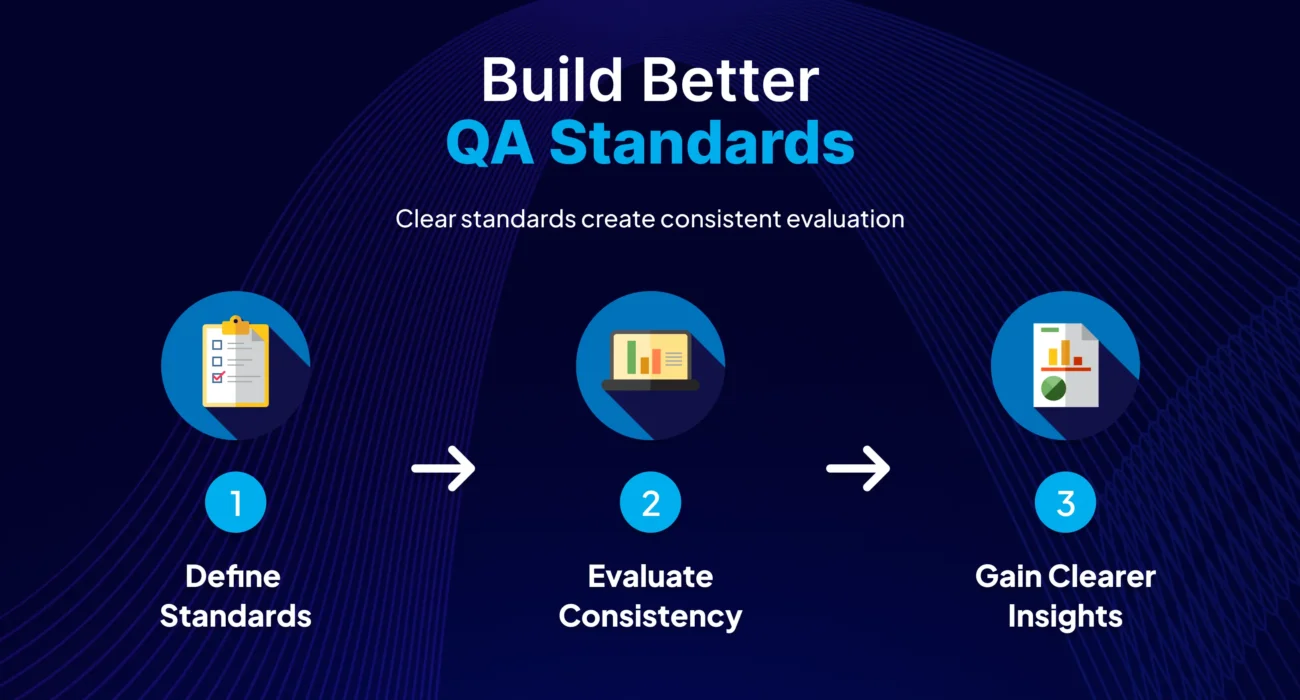
Velora operates through a clear three-step workflow:
1. Define Your Standards
Teams define the compliance and QA standards that matter most to their organization.
These standards may include:
- required regulatory language
- adverse event and product complaint detection
- script adherence
- empathy and professionalism
- knowledge-base usage
- intent accuracy
- call flow quality
- hold and mute behavior
- transfer handling
2. Assess Every Interaction
Velora automatically reviews customer interactions at scale.
Instead of treating quality assurance as a reactive manual task, the platform creates a steady, automated pipeline that evaluates interactions consistently and objectively.
This means organizations move from fractional sampling to total coverage.
3. Analyze the Results
Once interactions are evaluated, teams can analyze the results to uncover:
- recurring behaviors
- coaching opportunities
- compliance risks
- process gaps
- operational inefficiencies
- performance trends
This is where the true value appears.
Velora doesn’t just generate a score—it helps teams understand the factors driving that score.
From Individual Findings to Patterns Teams Can Act On
One interaction can reveal a problem. However, hundreds or thousands of interactions can reveal a pattern.
Velora™ helps organizations move from isolated findings to broader intelligence by identifying recurring themes across customer interactions.
For example, teams can identify repeated missed requirements, recurring knowledge gaps, common compliance failures, transfer trends, and coaching opportunities. In addition, organizations can uncover workflow friction that may be affecting customer experience or operational performance.
As these patterns become visible, leaders can make decisions based on evidence rather than isolated examples.
Therefore, instead of asking only, “Why did this call score low?” teams can ask more valuable questions: Why does this issue keep happening? Which teams are affected? What training should be prioritized? Which process needs to change?
Ultimately, this is how QA becomes more than oversight—it becomes a driver of continuous performance improvement.
Built for Compliance-Driven Environments
For organizations in regulated industries, the cause behind a QA score can be even more important than the score itself.
Velora acts as a compliance gatekeeper for customer interactions, especially in highly regulated environments such as pharmaceutical contact centers.
Its compliance engine is designed to help organizations detect and monitor:
- adverse events
- product complaints
- mandatory reporting flow adherence
- medical advice violations
- required regulatory language usage
It automatically flags critical failures and helps ensure that compliance issues do not remain hidden inside the large volume of interactions teams cannot manually review.
Once compliance checks are completed, Velora continues evaluating quality through its QA scorecard—creating a more complete picture of both performance and risk.
This combination of compliance, consistency, and complete visibility is one of the key reasons why AI-powered QA is becoming more important for modern contact centers.

Clear Evidence, Not Just Scores
Another major advantage of Velora is that it provides more than a result.
It provides context.
The platform delivers:
- automated scoring
- clear reasons for markdowns
- what went wrong
- where it happened
- timestamped evidence
- extracted operational and compliance datapoints
This helps reviewers move faster and make decisions with greater confidence.
Instead of manually searching through calls to understand an issue, teams can quickly review the evidence and focus on improvement.
That is especially valuable for:
- QA leaders
- compliance teams
- operations managers
- training teams
- performance coaches
When the reason behind the score is visible, corrective action becomes much more precise.
Operational Impact Beyond QA
Velora is not just about scoring calls.
It helps organizations improve operations more broadly.
By capturing datapoints such as transfer status, intent-based routing, compliance triggers, and recurring workflow issues, the platform gives teams visibility into what is happening across the business.
This can support:
- faster issue detection
- better coaching decisions
- stronger compliance oversight
- smarter process improvements
- more consistent customer experiences
- improved readiness across teams
For organizations that want to evaluate their current state before scaling improvements, the AI-Powered Contact Center Assessment can help identify key quality, compliance, and workflow gaps that may be affecting performance.
From Manual QA to Intelligent QA
Traditional QA often becomes a race to meet review quotas. Teams review a small sample of interactions, document findings, assign scores, and then move to the next review.
However, this approach makes it difficult to achieve complete visibility or identify recurring patterns.
Velora™ changes that process. By using AI-powered analysis across customer interactions, organizations can move from limited sampling toward broader and more consistent visibility.
As a result, teams can shift from scoring to root-cause analysis, from isolated findings to meaningful trends, and from reactive QA to proactive improvement.
Furthermore, automated analysis gives QA, compliance, training, and operations teams a shared view of the issues affecting performance.
Ultimately, quality assurance becomes more scalable, consistent, and actionable.
Find the Cause. Fix the Pattern. Improve Performance.
A QA score is important—but it should never be the end of the story.
The real value comes from understanding what caused the result and what patterns are shaping performance over time.
Velora helps organizations move beyond the score to uncover the behaviors, process gaps, and compliance issues driving customer interaction outcomes.
From missed requirements and knowledge gaps to recurring coaching opportunities, Velora turns individual findings into patterns teams can actually act on.
Find the cause. Fix the pattern. Improve performance.
If you’re ready to see how AI-powered interaction intelligence can help your team, explore Velora™ or contact VCloud Intelligence to learn more.
