
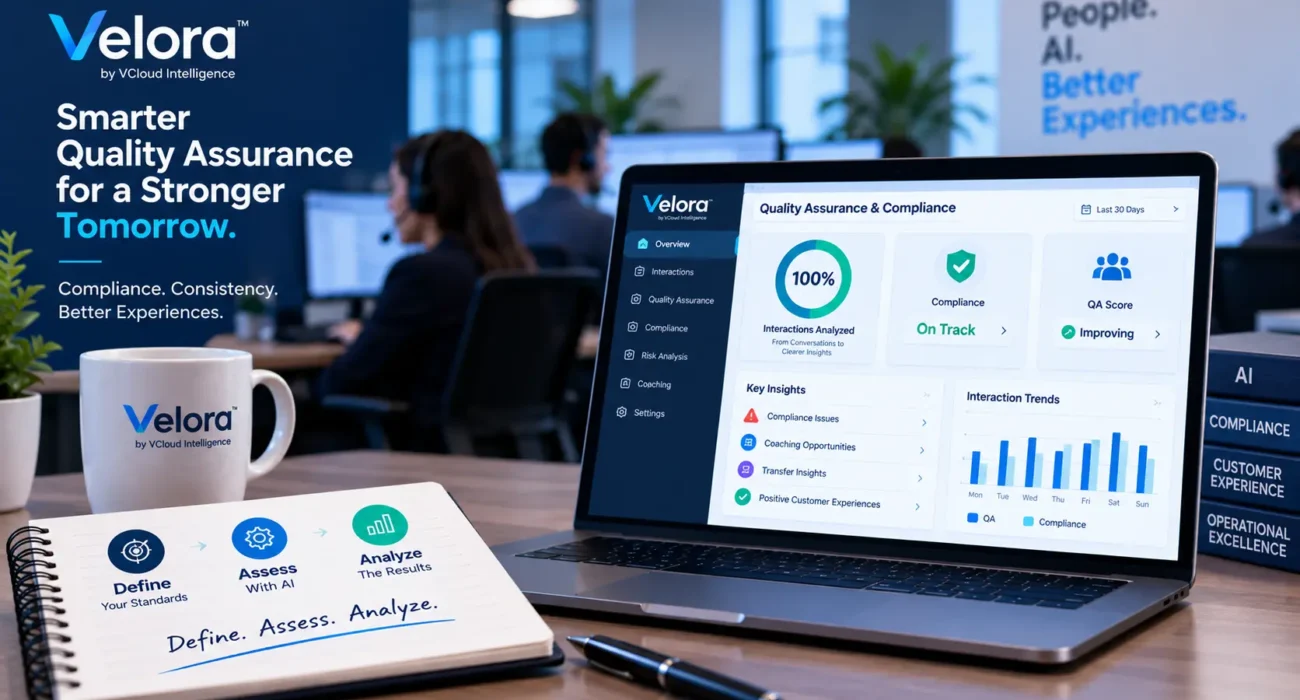
Quality assurance should not rely on guesswork.
However, many businesses still depend on limited manual sampling to understand what is happening across customer interactions. QA teams may review only a small percentage of conversations, while thousands of calls, chats, emails, and other interactions remain unchecked.
As a result, compliance gaps, inconsistent scoring, coaching opportunities, and operational trends can remain hidden.
Automated contact center quality assurance changes that approach.
With Velora™ by VCloud Intelligence, businesses can move from limited manual reviews to an AI-powered QA and compliance workflow designed to evaluate customer interactions consistently and at scale.
The approach is simple:
Define. Assess. Analyze.
First, organizations define the standards that matter most. Next, Velora™ evaluates interactions against those standards. Finally, teams analyze the results and turn customer conversations into objective business intelligence.
The Velora reference describes this exact shift from small QA samples to automated evaluation across customer interactions, creating a continuous QA pipeline instead of a manual review quota.
Table of Contents
Why Traditional Quality Assurance Creates Blind Spots
Traditional QA usually depends on sampling.
A quality team may review a limited number of interactions for each agent during a week or month. Although this process provides useful information, it does not always show the full picture.
Most interactions may never be reviewed.
Consequently, important issues can remain hidden inside the conversations that were not selected.
For example, one sampled interaction may show strong performance. Meanwhile, several other conversations from the same period could contain recurring process gaps or compliance issues.
Manual QA can also create scoring inconsistencies. Different reviewers may interpret criteria differently, especially when scorecards include subjective elements.
Therefore, organizations need a more scalable and consistent way to understand interaction quality.
What Is Automated Contact Center Quality Assurance?
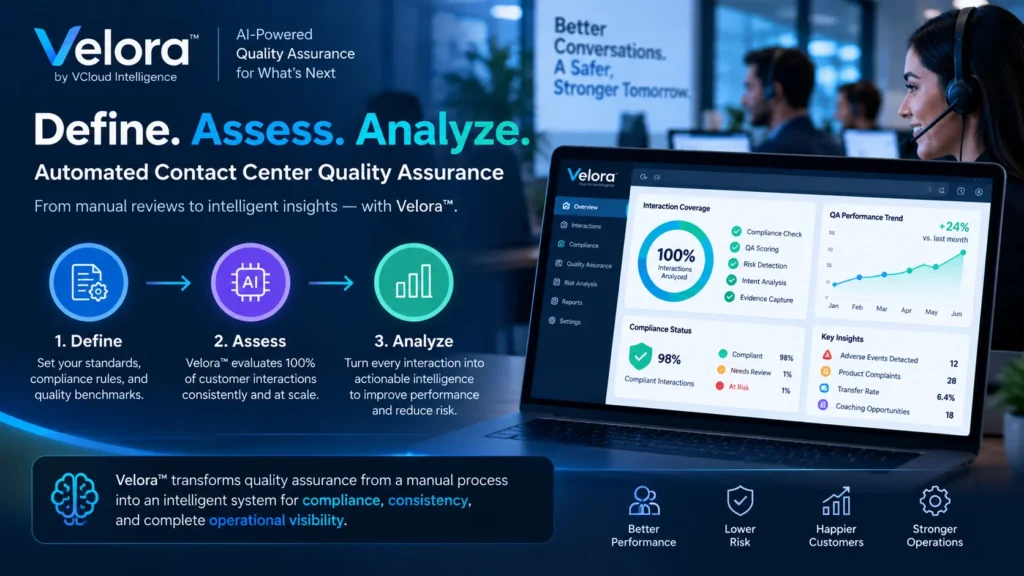
Automated contact center quality assurance uses AI to evaluate customer interactions against predefined quality, compliance, and operational standards.
Instead of requiring QA teams to manually select and score every interaction, AI can apply the same evaluation framework across a much larger interaction volume.
Velora™ is designed around this model.
According to the provided product material, Velora™ can automatically evaluate 100% of customer interactions, helping organizations move beyond small manual samples and gain objective, scalable intelligence across customer touchpoints.
This creates a stronger foundation for understanding performance.
More importantly, the workflow remains straightforward.
Organizations define what matters.
Velora™ assesses the interactions.
Teams analyze the results.
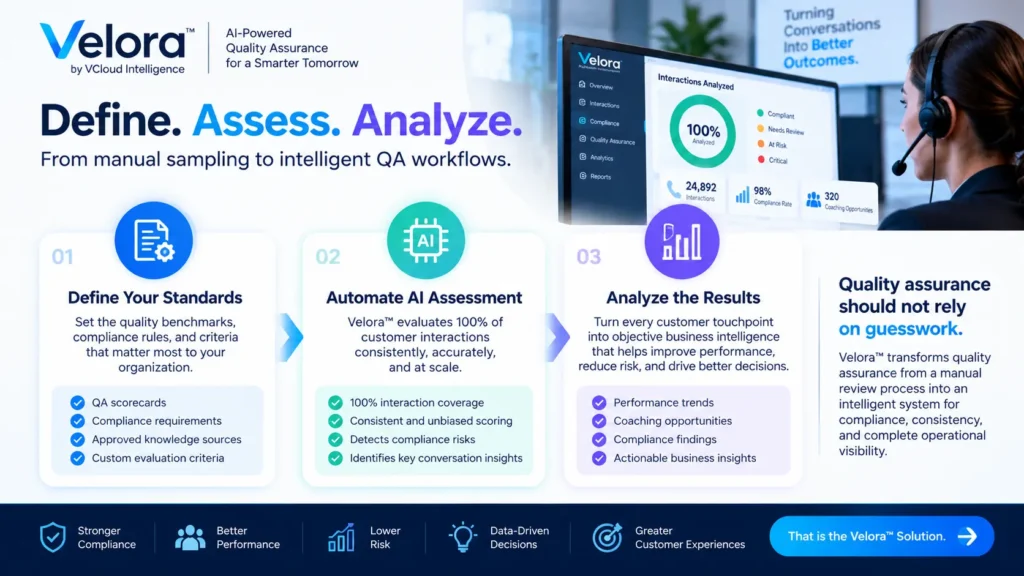
Step 1: Define Your Standards
Every effective QA program begins with clear expectations.
Before an interaction can be evaluated, an organization must define what strong performance looks like.
Those standards may cover quality benchmarks, compliance requirements, required language, script adherence, customer handling, approved knowledge usage, professionalism, intent accuracy, call flow, and other organization-specific criteria.
Clear standards matter because automation should not operate on vague assumptions.
Instead, organizations establish the rules and benchmarks that reflect their own quality and compliance programs.
As a result, every interaction can be assessed against a consistent framework.
This also helps reduce some of the variation that can occur when different reviewers interpret a scorecard differently.
Step 2: Automate AI Assessment
Once the standards are defined, Velora™ evaluates customer interactions against them.
This is where automated contact center quality assurance creates a major difference.
Rather than relying on fractional sampling, organizations can expand visibility across the interaction set.
Velora™ is designed to turn QA from a manual, reactive process into a steady automated pipeline.
Therefore, teams can identify issues that may never appear in a traditional random sample.
Automated assessment can help surface patterns related to quality, compliance, knowledge usage, scripts, workflow handling, and operational performance.
Furthermore, the same evaluation logic can be applied repeatedly across customer conversations.
That creates greater consistency and broader visibility.
Step 3: Analyze the Results
Assessment is only the beginning.
The real value comes from understanding what the results mean.
After interactions are evaluated, teams can examine scores, findings, evidence, and recurring patterns.
For example, one poor interaction may represent an isolated issue.
However, the same problem appearing across dozens of interactions may indicate a larger training, process, or knowledge gap.
Similarly, repeated compliance findings can show where procedures need additional attention.
This is where QA becomes more than a scoring exercise.
Instead of reviewing individual interactions in isolation, organizations can use the results to understand broader performance trends.
Consequently, customer conversations become a source of business intelligence.
Move Beyond the Final QA Score
A QA score tells you the result.
However, teams also need to understand what caused that result.
Velora™ is designed to provide more context around interaction assessments.
The supplied product material states that the assessment engine generates automated scoring based on compliance and QA standards while also providing explanations for markdowns, including what went wrong and where it occurred. Findings can also be supported with timestamped evidence.
That context makes QA findings more actionable.
Instead of seeing only a low score, teams can understand the behavior or issue behind it.
For example, the cause may be a knowledge gap, a missed requirement, a process issue, or a recurring coaching opportunity.
Once the cause becomes visible, teams can take more targeted action.
Connect Quality Assurance and Compliance
Quality and compliance often exist within the same customer conversation.
An interaction may provide a positive customer experience while still missing a required process step.
Likewise, an agent may follow a compliance requirement but struggle with professionalism, intent accuracy, or interaction control.
Therefore, evaluating quality and compliance together can provide a more complete picture.
The Velora reference describes assessment across areas such as script adherence, empathy and control, intent accuracy, approved knowledge usage, professionalism, call flow, and compliance requirements.
This helps organizations understand not only how an interaction performed, but also where risk or inconsistency may exist.
As a result, QA and compliance teams can work from a broader view of interaction performance.
Turn Customer Interactions Into Operational Intelligence
Customer conversations contain more than quality scores.
They also contain information about workflow performance, customer intent, transfers, escalations, and process effectiveness.
Velora™ can capture operational datapoints such as transfer tracking and intent-based routing. The reference material also describes custom datapoint extraction for regulatory and operational triggers.
This allows organizations to identify patterns that extend beyond traditional QA.
For instance, repeated transfers may point to a routing issue.
A recurring customer intent may reveal a knowledge gap.
Frequent coaching findings may indicate a broader training requirement.
Consequently, automated QA can become a source of operational visibility rather than simply a scoring system.
Reduce Manual QA Work
Automation does not mean removing people from quality assurance.
Instead, it changes where human expertise is used.
Traditional QA requires teams to spend significant time selecting, reviewing, and scoring interactions.
With AI assessment, the repetitive evaluation process can be automated.
As a result, QA professionals can spend more time reviewing important findings, investigating issues, coaching employees, refining standards, and improving processes.
Human judgment remains important.
However, teams no longer need to spend as much time manually searching for the interactions that deserve attention.
Build More Consistent Quality Assurance
Consistency is another major benefit of automated QA.
When different reviewers assess the same behavior differently, quality scores can become difficult to compare.
Clear standards combined with automated evaluation can help create a more repeatable process.
The same criteria can be applied across agents, teams, and interactions.
Therefore, leaders gain a more consistent foundation for performance analysis.
This also makes trends easier to interpret over time.
Instead of wondering whether a change in scores resulted from reviewer differences, teams can focus more attention on the underlying performance patterns.
From Manual QA to an Intelligent System
Traditional quality assurance often revolves around review quotas.
Teams review a certain number of interactions, complete scorecards, document findings, and move on.
However, completing a quota does not necessarily provide complete visibility.
Velora™ changes that model.
Instead of treating QA as a periodic manual task, it creates an automated process for evaluating customer interactions and analyzing the resulting information.
The provided Velora material describes this transformation directly: quality assurance moves from a manual task into an intelligent system designed to deliver compliance, consistency, and complete visibility across interactions.
That is an important distinction.
The goal is not simply to score more conversations.
The goal is to create a smarter system for understanding them.
Enterprise-Ready Quality Assurance
Large organizations also need QA technology that works within existing environments.
The Velora reference describes enterprise security protocols, role-based access controls, and integration with existing systems without disrupting current workflows.
This allows organizations to expand interaction intelligence while maintaining their existing contact center processes.
Furthermore, enterprise teams can use broader interaction visibility to support QA, compliance, coaching, and operational decision-making from the same intelligence foundation.
Organizations looking to understand their current QA environment can also explore VCloud Intelligence’s AI-Powered Contact Center Assessment alongside the ongoing capabilities of Velora™.
Define. Assess. Analyze.
Quality assurance should not rely on guesswork.
With automated contact center quality assurance, businesses can move from limited sampling toward a more structured and scalable QA process.
Define your standards.
Establish the quality benchmarks, compliance requirements, and evaluation criteria that matter most to your organization.
Assess the interactions.
Use AI to apply those standards consistently across customer conversations.
Analyze the results.
Turn findings, evidence, trends, and interaction data into objective business intelligence.
Velora™ transforms quality assurance from a manual review process into an intelligent system for compliance, consistency, and operational visibility.
Define. Assess. Analyze.
That is the Velora™ Solution.
Explore Velora™ to see how VCloud Intelligence can help transform customer interactions into actionable QA, compliance, and operational intelligence.
